|
Construction
The basis
of the kit is Hasegawa’s series of 48th scale Zero’s. The
kit features recessed panel lines, a decent out of the box cockpit, a nicely
represented Sakae 12 engine (although later molds are beginning to show some
signs of age, I had to rummage through a couple of kits to secure the engine
pieces, some of the cylinders were badly misaligned) and overall accurate
dimensions, a good starting point for my first “real” attempt at scratch
building.
| I
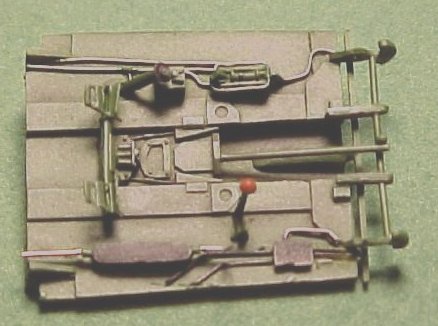
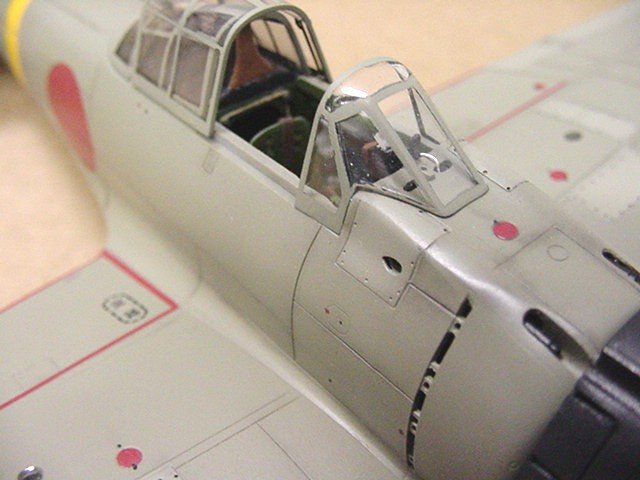
started in the cockpit, with the excellent Hawkeye Designs A6M interior
set. The set is intended for A6M3 variants, but the
differences between the A6M2 and 3 models are slight, and no major
modifications to the set are needed. First was the cockpit
“floor” which is actually the top of the wing. I cut the Hawkeye
floor in half, at the recessed area for the rear bulkhead. I added
the rudder and elevator bell crank assembly at the rear of the floor,
using sheet styrene and some pieces from the spares box. I added a
voltage |
|
| regulator,
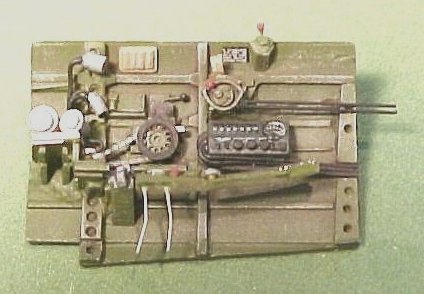
and some various boxes with lead solder hyd lines. Next was the
cockpit sidewalls. On the original, the cockpit “floor’ actually
slants down towards the rear. To simulate this, I added 1mm shims to
the cockpit sidewalls, to give the impression of the floor/wing top
slant. The left sidewall received scratch built Dyanmotor assemblies
(to provide power for the radio receiver transmitter on the opposite
side), I removed the molded on trim wheel and chain and added pieces from
an Eduard set, and added the various linkages from the throttle quadrant
to the firewall. I added the throttle lever from a piece of a
toothpick (to simulate its wooden predecessor). The instrument panel
is from the kit piece, with kit decals with epoxy faces. The right
side cockpit features a scratch built radio/receiver transmitter, cockpit
vent tube from solder, and all the flap and landing gear hyds plumbed in
(see photos). The rear bulkhead was extended to the floor of the
fuselage, and the seat elevation mechanism was added from pieces from an
Eduard set again, with a Cutting Edge Zero seat. |
The cockpit
interior was painted with MM Field Green with a drop or two of MM Flat Black,
lightly drybrushed and weathered with pastel chalk. Total building time on
the cockpit took about 3 months (I’m slow).
The engine vent
louvers on the fuselage sides were thinned out and opened, I added an oil tank
from sandwiched sheet plastic to the engine firewall, which was made again from
styrene, along with engine bearing struts (all of which is invisible when the
fuselage was assembled).
|
Click on
images below to see larger images
|

|
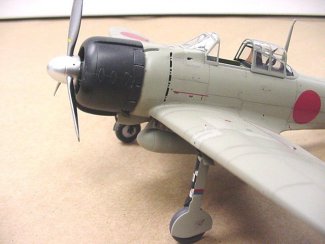 |
The kit
fuselage is shared with its Rufe cousin, and a small mold line exists at the
rear of the fuselage, just forward of the vertical stab. A couple of quick
passes with a sanding stick took care of the problem.
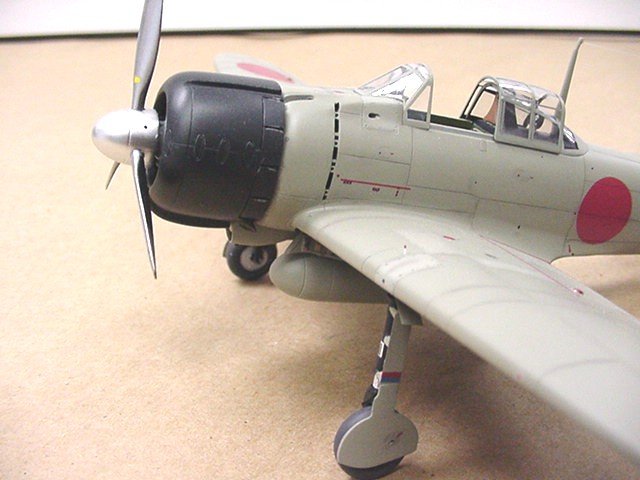
The wings were
assembled per kit instructions; I do however attach the top portion of the wings
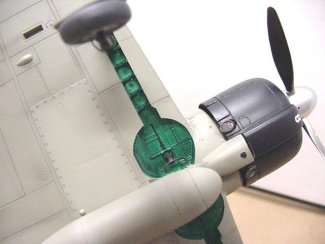
to the fuselage first, to ensure no gaps. I added the fresh air vent on
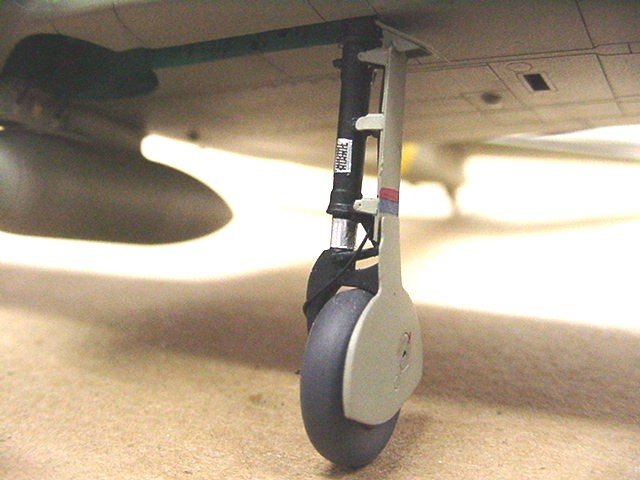
the starboard wing, and detailed the wheel wells with PE pieces from the Eduard
set again. The kit landing gear struts were used, but I modified the landing
gear doors. On the original, the upper and lower doors are separate units,
I used sheet styrene to fabricate the upper assy, again with Eduard PE for the
attachment lugs, and thinned the lower assy and added to the gear legs.
The blue/red weight indicator marking was painted on at this time, wire brake
lines added at the end.
|
Click on
images below to see larger images
|
|

|
|
The
engine received scale push rod assys, ignition wiring added to the ign
ring and cylinders, and I also scratch built the cowling mount ring
(again, invisible in the cowling). The engine was painted in Floquil
Weathered Black, with gloss black push rods and a medium gray case.
The rest
of the kit was assembled per instructions.
Painting
and Markings |
Click on
image below to see larger image
|

|
|
There has been
much debate on the latest color schemes of early Zero’s. I recommend
anyone interested go over to j-aircraft.com and look at the various research
articles on finishes.
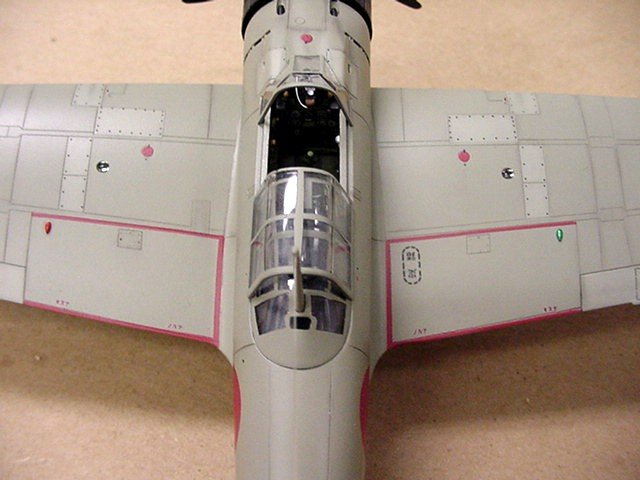
The basic
overall color of my Zero is a 50/50 mix of Floquil Enamel Concrete and
Aeromaster RLM02. The wheel wells were painted in Old Silver first,
followed by a Clear Green/Blue mix. Notice that the landing gear doors are
also the fuselage color, Mitsubishi made Zeros had this feature, while later
Nakajima built Zeros had Aotake applied to the gear doors as well as the wheel
bays.
The wing and
fuselage Hinomaru’s were painted using Eduard masks, wing walks were also
painted and masked, and the yellow tail band was airbrushed also. A coat
of Pollyscale Clear Gloss followed.
The tail code
decals were provided by Dave Pluth, the fuselage CG markings and the aileron
balance markings were provided by Mike Grant decals. They all worked out
great, and I highly recommend Mike’s decals.
Weathering is
pastel chalk, applied with a fine paintbrush, with the excess removed
immediately. A coat of Pollyscale clear flat finished everything off.
Acknowledgements
I would like to
thank Greg Springer who continually provides me with info I seem to miss, Ryan
Toews who provided an absolute treasure trove of Zero stenciling data as well as
painting info, John Greiner for taking the photos of the finished product, and
last but never least, Josh Bowling and Scott Brown for having to endure all my
neurosis’ and disappointing 2 and ½ hour car ride back from a show.
Tom
|
|