|
I'm sure most of you know the history of the A-10. Destined for the
boneyard, Operation Desert Storm saw the 'Hog' emerge as one of the United
States' military's most valuable, lethal assets. After the A-10 proved
itself in combat, only half the fleet was mothballed, and the remaining 300 or
so have served with distinction over Southwest Asia, the Balkans, and most
recently, Afghanistan. Hogs currently outfit eight active duty operational
squadrons, three Air Force Reserve units, and six Air
National Guard units.
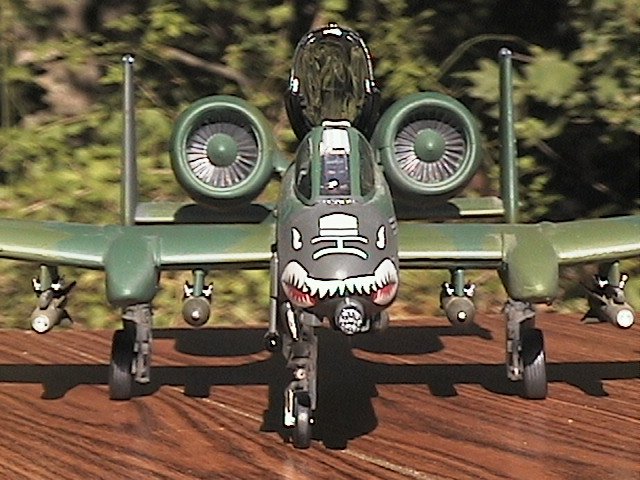
I used the very nice Monogram 1/48 scale
A-10 Warthog. Much has been said of the fit of the kit, but in the two I
have built, the fit problems have really been minimal, at least relative to some
of the negative comments. Sure, some putty and sanding will be needed, and
rivets WILL be lost, but the final product is a fine representation of the
ultimate ground attack jet.
Typical of Monogram kits, the detailing and
accuracy is very good.
The cockpit is reasonably nice, though in the future I will use the new Legends
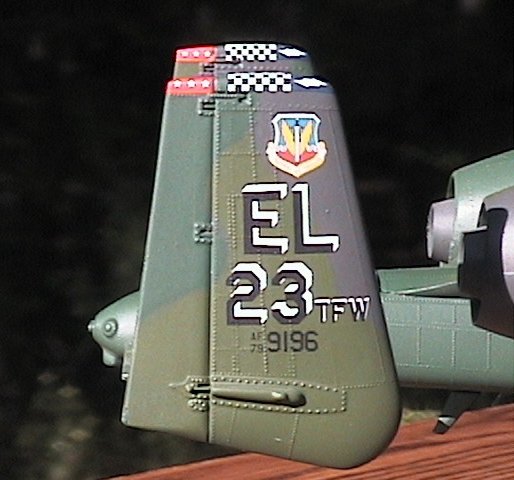
Productions cockpit set. The rivet detail is exceptional, and is
especially visible on the vertical stabilizers. All in all, a very
accurate kit.
Wanting to do a Lizard scheme A-10, I bought the CAM
Decals sheet 48-094 "Hog Wild." With the Superscale 23rd Fighter
Wing decals hard to come by, this sheet is a more-than-acceptable substitute.
The decals lay down beautifully, especially with some Micro-Set and Micro-Sol.
They're very thin, and really do look painted on. I was especially pleased
with the shark mouth!
Wanting to do a Desert Storm jet, I needed to replace
the serial numbers provided on the sheet. It comes with a 23rd TFW
flagship with the numbers 80-0191. According to "Fairchild Republic
A-10 Thunderbolt II" by Peter C. Smith ( a very good book, by the way), a/c
80-0191 didn't serve in the conflict. Another great book, "Republic's
A-10 Thunderbolt II - A Pictorial History," showed a/c 71-9196 as having
the same markings, and this one did serve in the conflict. So just swap
serial numbers and you're all set.
One
note about the decals: the tail cap doesn't quite fit! The portion
on the main stabilizer is too short horizontally, so there is a gap between it
and the marking on the top of the rudder. I elected to just leave it as
is, and isn't too noticeable. Hell, Hogs weren't meant to look pretty!
Model Master Acrylics were used for the two
shades of green and dark gray. After gloss-coating, the decals went down
very nicely, and it was time for the best part: the weapons.
I chose to load out the Hog for one of its many
missions in Desert Storm, and one of the pilots' favorites: tank-busting.
As was pretty standard in the war, two AIM-9's are carried, as well as an
ALQ-119 jamming pod, which was carried by all CONUS based A-10's. Though
AGM-65D infra-red Mavericks were used most, the electro-optical B-
models were used, especially early in the war. And early in the war, both
squadrons of the deployed 23rd -- the 74th and 76th -- flew daylight missions,
before the 74th switched over to night sorties. So B-model Mavericks are
on scratchbuilt single-launch rails, and six cans of Mk 20 Rockeye II cluster
bombs round out the loadout. Rockeye II was used early in the war against
heavy armor, but it was found that it was rather
ineffective against the "big boys," like the T-72. So those poor
Hog Drivers had to resort to using Mavericks and the gun!
Well, that's about it on this Hog.
The Monogram kit really is nice. I learn how to improve it with each one I
build. If you want a really good read, I highly recommend "Warthog:
Flying the A-10 in the Gulf War," by William Smallwood. It hooked me
on Warthogs! Next up is a gray A-10.
Now where are the decals?
Tom
|
|