|
Building Emerson's P-51D-5-NA
Mustang. This being my 5th Mustang you might be thinking
"Mustang Nut", but not so! Bent wing all the way,
dating back to when Dad worked on the Corsairs at Goodyear Aircraft
Corporation in Akron, Ohio. When this Mustang was done it was the last one for a long time. However, with this being
Mustang #5, I had the advantage of all the drawings, correct
measurements and photos from my previous research.
According to "Warbirds Worldwide" book
#28 there is only one photo of Emerson's P-51D-5-NA. This
picture, which was published in their book #28, was taken from a
B-17 during the war. Mike Meek, a member of IPMS/Silicon
Valley, loaned me his copy of the book so that I could take some
close-up pictures. The Story in the book says that Emerson
flew the aircraft, but while on Stateside leave around July'44, the
aircraft was assigned to another pilot. Before his return to
Europe he was promoted to Captain. Then on December 25th,
1944, in his new aircraft, Capt. Donald R. Emerson was killed in
action. This means that "Captian" Donald R. Emerson
never flew this particular P-51D-5-NA.
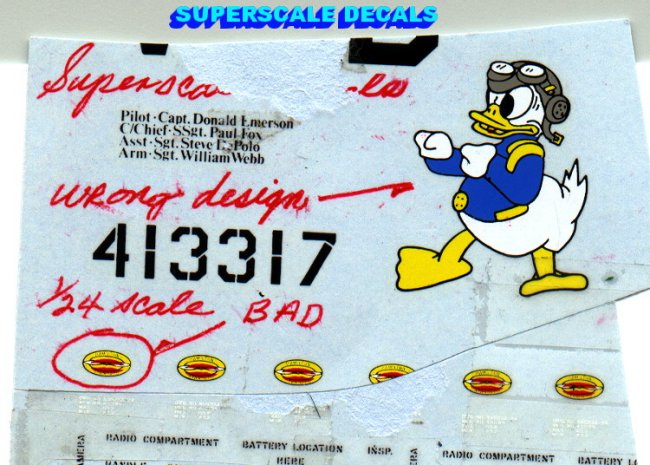
Now, what I.D. should be put on the model?
Lieutenant or Captain! Remember, never trust art
drawings!! In the new Mustang book #13 by Aero Detail on page
54 the drawing shows this particular P-51, serial number 413317, as
being number 413917. To add to the confusion the enlarged
"Duck" drawing is not exactly like the small one on the
side of the aircraft and neither one looks exactly like the one on
the real airplane. The pictures made from Mike Meek's book
also showed that the "Donald Duck" is different from the
Superscale decal sheet #32-6. Moreover, the Text with the
drawings is labeled Major Emerson, September 1944. The call
letters of "VF*B" on the fuselage are, however, correct.
| Click on images below to
see larger images |
 |
 |
 |
 |
Before we begin building we must talk about
handmade parts and superglue. Well, when speaking of handmade
parts be assured that, that is just what they are - handmade.
The tools used to create these parts consist of 2 Dremel motors,
several files - ranging from a rough bastard cut to a superfine #6
cut - Flex-I-Files, cutting knives, and my brain. There is no
drill press or machinist lathe, but maybe someday. As for
superglue, it is for building, filling - gaps and seams - and
tacking parts together. I use the thin for tacking and the
thick for filling. (Here is a modeling tip to use when using
Zip-Kicker. attach a hypodermic needle to the bottle. after about 5 to
10 seconds apply a drop or two of the kicker them immediately apply
water to the area. Remove the water and apply more super
glue. The glue will not bubble and you will be ready to cut, file
and sand. One thing to remember when working with superglue, never
apply it unless you can start the cut, file and sand process
immediately. After a day or two superglue gets as hard as steel
and is extremely difficult to work with.
|
Click on image to
right to see larger image |
Work on this particular Mustang begins with the fuselage instead of
the usual wheel wells and wings. The client wanted the rudder and
other flying surfaces off set. This made it necessary to remove
the rudder from both halves of the fuselage. To accomplish this
the halves were taped and the rudder section was tacked with
superglue. This method gives you the correct angle for the rudder
once it has been separated from the fuselage.
|
|
The leading edge of the rudder was filled with white styrene and
sanded to shape. A new trim tab was fashioned from .090" flat
styrene after the kit tab was cut away. Then an angle plate was
made from .050" aluminum. It was glued into a pre-recessed
location at the bottom of the trim tab. Next a hole was drilled
into the forward area of the rudder. Inserted into this hole is a
piece of .030"o.d. / .015" i.d. stainless steel tubing.
An actuator arm was fashioned by using a piece of .015" o.d. brass
rod flattened on the end and filed to shape. Then a .010"
diameter hole was drilled in the flattened end of the brass rod.
Into this hole and the matching hole in the plate on the trim tab insert
a piece of .010" o.d. white styrene rod. The rod is then cut
to length and mushroomed over using a heating iron.
While working on the inside details I decided to build in
transportation supports. These come in handy when traveling to and
from contests. Just make front and back support brackets in your
model carrying box, remove the prop and rudder, insert tubing
through these brackets into your model and you're ready to go.
| Now we move to the inside of the fuselage.
The rib sections and
the tailwheel well are constructed using flat |
|
|
| styrene stock. As
for the carburetor air scoop intake I used 1/2" round tube.
The holes for the air filters on both sides of the fuselage were drilled
out then thinned to scale. Attached into these holes is fine
stainless steel screen. As a side note on the use of screen for
detailing, never place a screen inside the carburetor air scoop intake
as there never was one installed in this location. |
|
|
The tailwheel assembly from the kit was tossed out keeping only the
tire. To this was added a new rim, built from telescoping
aluminum tubing, and an axle and support shaft crafted from .060"
o.d. round brass rod.
The rest of the assembly was made from
styrene and aluminum. The doors were fashioned from .005"
thick aluminum sheet stock (beer / cola cans) and styrene. Before
joining the fuselage the tailwheel got it's first coat of paint. |
| Click
on image below to see larger image |
 |
 |
|
Next came the tail plane. The two halves of the stabilizer /
elevator were joined together then all of the raised rivets, panel lines
and access doors were removed. Then the trailing edges were
thinned to scale. Using pencil lines to draw on the elevator I
took my jeweler's saw with an extra fine blade and separated the elevators
from the stabilizers. At this point the trailing edge of the
stabilizer and the leading edge of the elevator were filled with styrene
and sanded to shape. A new trim tab, built out of styrene, was
added. It included the cutouts, hinges etc.
| Once the sanding was completed - I used up to 1500 grit wet / dry
sandpaper - it was time to replace the panel lines, rivets and access
doors. After drawing the lines for rivets, panels and doors,
masking tape is butted together leaving a small gap for the scribing
tool. Each panel line is scribed three times. For the
rivets, I use a sharpened needle point .010" diameter drill bit to
push gently into the plastic. Once these applications are
completed the area is resanded with 1500 and 2000 grit sandpaper. |
| Click
on image below to see larger image |
 |
|
Since my tri-tool scribing template has no rectangular patterns I use
templates made from .005" aluminum can stock. These were made
by drawing the desired patterns on the aluminum, scribing around them,
then drilling .015" holes in the 4 corners. Next an
"X" is cut into the aluminum, a .30" diameter hole
drilled in the center, and then gently flex the aluminum. Now dress up the
edges with a #6 file and 600 grit sandpaper.
|
|
Click
on image below to see larger image
|
 |
|
Cockpit
|
|
| The cockpit was constructed
using some parts from a Verlinden cockpit kit, the kit cockpit and many
scratch built detail parts. The Verlinden kit supplied the floor,
seat and lower section of armor plate. These were joined by the
kits upper section of armor plate/head rest. Some extra styrene
was added to the floor so that it would fit snugly into the
fuselage. Fellow IPMS/Silicon Valley Scale Modelers Club member
Jim Lewis, showed me how to simulate cloth/canvas by using facial tissue
and white glue. So I used it to make the cushion for the back of
the seat. Nylon ribbon was used as belt straps along with the
buckles from the Verlinden kit. Their control stick was also used.
|
| Click
on images below to see larger images |
 |
 |
|
Rodney
|
|