|
Monogram
has a knack for capturing the true likeness of an aircraft in a scale model.
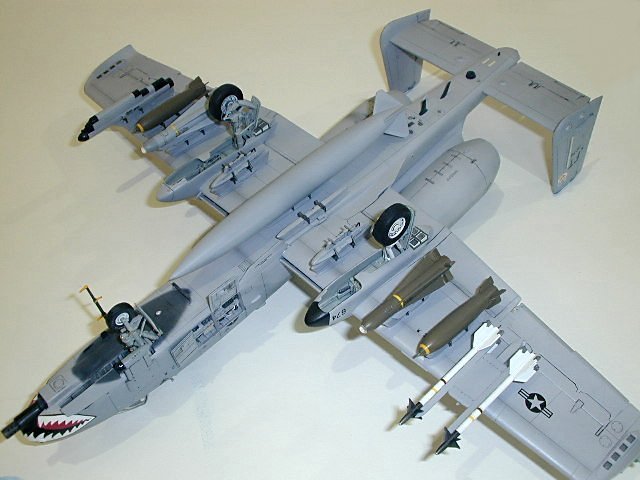
This is definitely true for the 1/48 scale A-10A.
Despite of the age of a majority of the Monogram kits, some have
exceptionally good fitting parts while others provide a challenge.
The latter is also true for A-10A kit.
The fit is so atrocious that I can’t fathom how some people can say
they can built this model without loosing a raised rivet or raised panel line
and still achieve smooth seamless joints!
If there were a test for modeling skill, I would have to say this kit is
the final exam for basic finish. But
despite some of the kit’s failings, an intermediate level modeler can produce
a fine looking model of the ultimate tank killer.
This
is the second Monogram A-10 that I have built; the first one in 1989 built
straight out of the box. The
first have since gone to the city bone yard after proving low thrust to weight
ratio is not conducive to flight. So
armed with knowledge of what to expect from this kit and being totally motivated
by the new A-10 resin cockpit from Black Box, I dived into my second attempt.
The
kit parts came in dark green styrene with standard raised panel lines.
The fuselage, stabilizer, and fin have delicate and beautiful raised
rivet details. An outstanding
feature of the kit is the fine molding on the landing gears, wheels, nose gear
bay, and the beautifully shaped clear windshield and canopy.
Molding flash are found on some parts.
Construction
My
philosophy for building a Monogram kit is the panel lines must be rescribed.
Using the original raised panel lines and the Squadron A-10 Walk Around
book, I begin the work. One
of the “secrets” to scribing panel lines is to sand off only 80% of the
raised lines and use the remaining outline as the guide to scribing.
Scribing was done using a sewing needle and Dymo tape as the guide for
drawing the straight lines. Rivet
holes were drilled out using a #77 model drill bit which you can get at a fine
hobby shop like Uncle Bills in Calgary. This
took about 2 weeks to complete.
Cockpit
The
Black Box cockpit is fabulous! A
must have for this kit. Although
the basic kit cockpit is quite good, the seat really needs a resin replacement.
The seat of the kit’s Aces II seat is molded integral with the cockpit floor
and cutting it out is a mess. So
why not splurge and get a complete improved cockpit.
Typical with Black Box, fitting in the cockpit is an exercise in
patience. Dry fitting is an
absolute necessity to achieve good fit.
Start first by shaving off, with a No. 11 blade, the kit fuselage console
sidewall per Black Box’s instruction. Don’t
over shave and keep doing dry fit until perfect.
The resin sidewall comes with the cockpit heater pipes typical of A-10s
in the 80s. If you are doing a
modern A-10 like I am, shave off these heater pipes.
It is such a shame to shave off these fabulous details.
I didn’t do this on mine because I found this out after I finish the
cockpit. In order for the
nose gear bay to fit underneath the resin cockpit, cut and sand all the resin
off the side and bottom of the cockpit tub.
I do mean ALL. This will leave you with a very thin floor.
Be careful not to sand right through the tub.
The
resin Aces II seat is beautiful and the only addition I needed to make is to add
the launch rail cross brace near the top using 0.80” styrene C-Channel from
Evergreeen. I made the oxygen hose
on top of the starboard console by winding thin brass wire over a tightly
stretched thin brass wire. Control
levers were added using any left over photo edge scraps that resemble levers.
The tips of which were dipped into thicken cyanoacrylate and when dried
dipped into thicken acrylic model paint.
At this point, I cut off the kit HUD mount and store it for safe keeping
until needed.
| click on
the images below to load the full size photos |
 |
 |
 |
Here’s
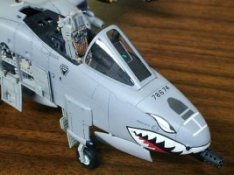
a tip. I found that by
lightly trimming the resin instrument panel sides I was able to this piece in
after I glue in the cockpit tub and assembled the fuselage. This provided me with two benefits: 1) I was able to use the
open instrument panel space to throw in more lead weights into the nose and, 2)
by putting in the panel in last, I can align the panel to fit both the tub and
the kit dash.
Nose
Gear bay
Using
the photos in the Squadron Walk Around book, I detailed the already detailed
nose gear bay using brass wires to simulate the piping.
I only needed to add 5 pieces of piping to the sidewalls.
I used brass wires to simulate the pipes.
Paint the gear bay with Aircraft Grey before gluing it in to the
fuselage. I like to
accentuate raised details by spraying on a darken base color over the raised
details and then dry brush a lighten base color over it.
Nose
weight
The
A-10 is a tail-heavy plane. To
determine how much weight is needed, tape the fuselage, wing, tail planes, and
landing gears together and keep taping lead fishing anchors to the nose until
the nose gear sits firm to the ground. Epoxy
in as many lead fishing anchors as you can into both sides of the nose.
Open
Panels
When
I started this project, I decided to open the starboard avionics and circuit
breaker panels to add some interest to the model. Following the scribed panel lines in this area, I cut
out the opening. Evergreen
0.03” thick styrene sheets were used to make the enclosing walls.
I sized the walls so that it will fit snug inside the fuselage cut out to
support the thin styrene framing that will be added after the model is finish.
0.08” C-channel is used to make the horizontal bracing.
Holes were drilled into the C-channel to simulate the lightening holes.
The fuse box and other boxes were cut from scrape resin bits.
Never throw anything away. Wiring
was made from thin brass wire.
The
two hanging panels were made from 0.01” thick styrene sheets.
To simulate ribbings on the panels, I used 0.015”x 0.04”strips to
build it up. The air scoops
were cut from 0.01” sheet and folded to form the scoops.
The skills I learned from making paper toys when I was a kid really help
here.
General
Assembly
After
fitting in the nose gear bay and starboard avionics bay, the fuselage is at last
glued together. At the same
time, take care in aligning the Black Box cockpit to the opening in the
fuselage. I use thin
cyanoacrylate to quickly hold it in place once I got the alignment.
The instrument panel was then glue in.
Despite my best effort, the resin instrument panel sits a bit higher than
the kit dash. I solved this problem
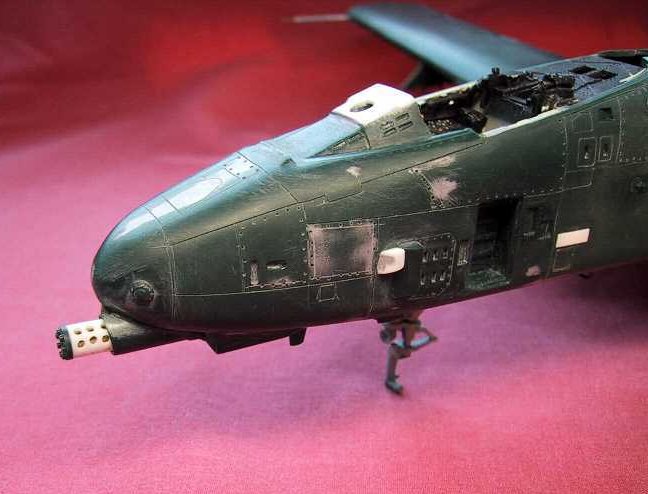
by making a styrene filler piece that lay over the dash and HUD area (see close
up of the unpainted nose section). This
filler was sanded to merge with the rest of the dash and thus obtained a perfect
fit.
The
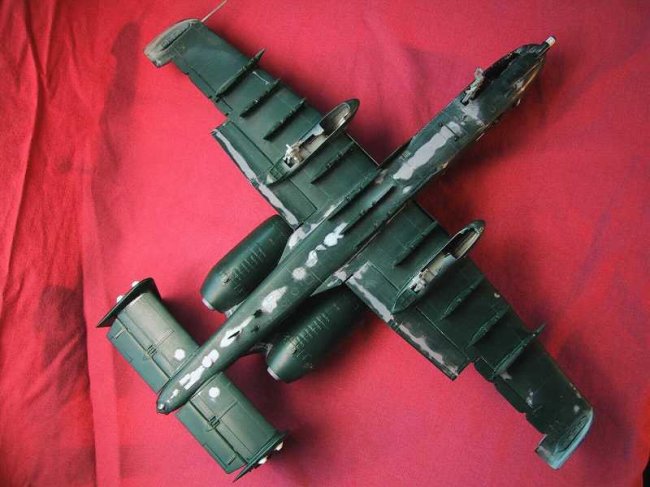
wing and the stabilizers were glued into place using liquid cement.
Liquid cement takes about a minute to set thus giving me enough time to
set the alignment for these parts. The
fit of the wing to the fuselage is very bad.
I find that no matter how much shaving I do to the wing root, I just
can’t get them to fit well at the top and bottom of the wing.
I tried to minimize the gap at the top of the wing and thus accepted
larger gaps to the bottom wing joint.
The large gaps were filled in with cyanoacrylate.
Large wing root gap is not the only problem, the wings will not glue in
exactly perpendicular to the fuselage.
I don’t think there’s much you can do about this.
You just have to fudge it.
The
engine intake and the compressor blades are molded as one piece.
This is pretty bad design. Worst
yet, this piece does not fit flush with the engine nacelle intake lip.
After gluing this piece into the engine nacelle and taking cares to align
it so that I get the minimum amount of misfit. I shaved and sand flush this piece to the nacelle intake lip.
Liberal amount of putty was used at this joint to ensure seamless joint.
Plenty
of sanding and putty is needed on the fuselage joints.
To make sanding easier, I cut off all the fuselage antenna and store them
for later restoration. There
are sink marks near the joint on both top and bottom of the fuselage.
The worst joint is the bottom fuselage joint where the joint dipped and
raised along the joint. This
is why I challenge anyone to prove their claim that they can build this joint
without loosing the rivets and still get a 100% perfect seamless joint.
The
air intake scoop located atop the fuselage between the engine nacelles was
drilled out and a sharp No. 11 blade was used to refine the openings.
I break out the gap filling cyanoacrylate and putty again to glue the
engine nacelle to the fuselage. This
joint leaves a 1/16” gap everywhere no matter how I align it.
The
Monogram kit was missing a small gun exhaust cover that is located under the
windshield on the port side. The
small cover was made from pieces cut from styrene sheets and glued together.
| click on
the images below to load the full size photos |
 |
 |
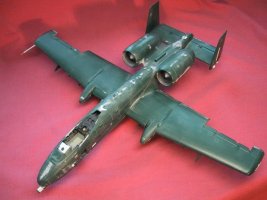
As
evident from the pictures, mucho putty was used for this kit to achieve a 100%
seamless joints. Sanding and putty
work took over two weeks to complete. To
check the progress of the seam sanding and putty work, I hold the piece under a
light and view it at different angles.
The other key to good seam work is to do 80% of the work using various
grades of wet sand paper; work from course to ultra fine.
Good seam work is basic to plastic modeling.
You can never spend enough time on this aspect of the work. I have seen
so many models with good paint jobs that lost at model shows only because the
basic seam work was not good enough.
More
sanding and putty is required for the huge gap at the bottom wing section joint
at the wing tips. Even more
putty is required at the bottom wing joint on the flaps. I swear I used up half a tube of Tamiya putty.
After
filling in the major seams, I rescribed all the missing or filled in panel lines
back in. This includes the
wing joint and anywhere else where panel lines need to connect.
This is another weak area I notice some modelers have.
I have seen models with good paint job, even good seam work, but the
builder just didn’t bother to go back and fix up the sanded over seams!
When do panel lines on the real aircraft just suddenly disappears?
It is really disappointing to see some Judges don’t pick up basic thing
like this and awards a first place to models with this kind of defect.
The
kit came with the speed breaks in the open position. I much prefer a clean look on the wing so I cut the
speed breaks off and glue them in the close position.
The only trick here is to do a lot of shaving on the trailing edges of
these speed breaks to fit.
|
The
kit gun barrel cover just doesn’t cut the mustard. So, I scratch built the gun cover using 3/16” dia.
styrene tube and reused the kit’s gun cover plate.
I carefully layout the hole pattern on the gun cover and dilled.
Though it is not so evident on the photos, I did glued in brass
wire to represent the gun barrels inside the cover. |
| click on
the image below to load the full size photo |
 |
|
Hydraulic
lines on the landing gears were represented using thin brass wires.
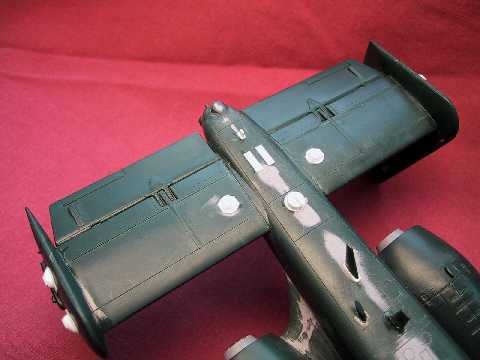
The
kit pitot tube on the starboard wing tip is way too weak.
I replaced the kit part with aluminum tube and a piece of brass wire for
the tip. The tip of the tube
where it meets the wire tip was 50° tapered.
When done the new tube was glued in a pre-drilled hole in the wing tip
using cyanoacrylate. There, the landing gears will fall apart long before
this pitot tube will break off.
LASTE
mods
All
modern A-10s have been upgraded with the LASTE modifications.
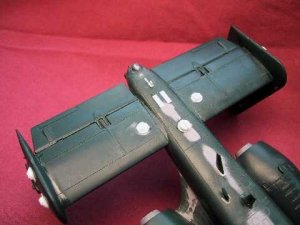
I incorporated the mods to the model by scratch building all the radar
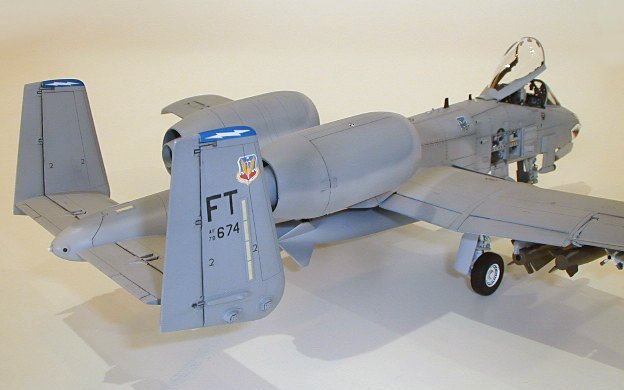
blisters and mods. The blisters on the rudder fins were made from three
layers of 0.03” thick styrene sheets and sanded to shape. I photocopy a large image of the rudder fin from the
Squadron Walk Around book. This
image is scaled down using a photocopier to exactly the same size as the kit
rudder fin. The image of the
blisters on this scaled image was then used as the template to scratch built the
model blisters.
|
Thanks
to a suggestion from a fellow web surfer on the ARC web site, I made the
blisters on the bottom of the stabilizers from the clear lenses for the
Maverick missiles. The
crown of the lens was sanded flat and a piece of square styrene glued on
top of it to form the cover for the blister. |
| click on
the image below to load the full size photo |
 |
|
The
modern A-10s have 2 fuel vent pipes sticking atop of the fuselage, located
between the antenna blade and the formation light. I made these vents out of 0.04” dia. styrene rods and the
holes drilled out.
The
big circular antenna at the bottom of the rear fuselage was made from a 3/16”
dia. styrene tube with styrene cover plate and styrene sheet antenna blade.
The
front and rear radar warning antenna covers were removed from most A-10s long
ago. So, these covers, one at
the rear fuselage and one at the nose, were cut out and putty over.
When
gluing back the antennas that I cut off earlier, I make sure the antenna blade
at the bottom of the nose is relocated to a location next to the boarding
ladder. I checked with my
references and was assured that this must be done.
Before I glue an antenna onto the model, I made a mounting base for each
antenna using styrene sheet. The
mounting base for an antenna on the real aircraft is typically about 4” wider
than the antenna on every sides and is used to bolt or rivet the antenna to the
plane.
Those
tiny antennas on the wing tips (2 per wing tip) were made from model railroad
parts that I found in a train hobby shop.
No magic here, just simply went to train hobby shop and looked for any
parts that resembled one of those thing-a-ma-jig.
Some,
not all, A-10s have the GPS dome on top of the fuselage, right between the two
antenna blades. The photograph of
the plane AF78674, which I was modeling, appear to not have the GPS dome.
Underwing
Stores
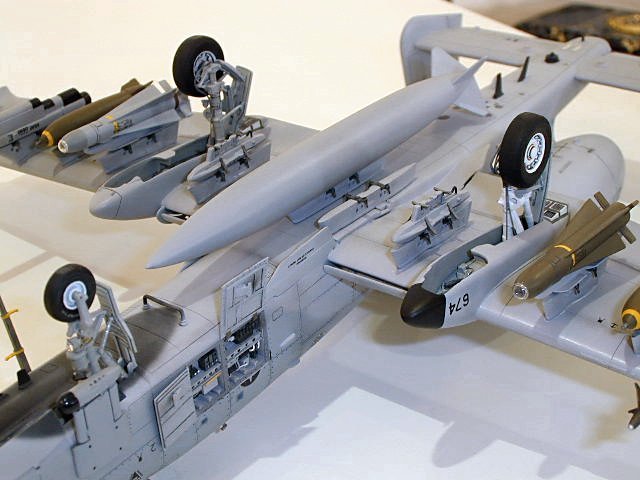
The
side winder dual missile rack that came with the kit is not correct for the
modern A-10s. To get it right, I
scaled the dimensions provided on the ARC walk around photos by Chris Andreychik.
The dual missile rack base was made from sheet styrene built up and
sanded to the contour shown on Chris’s photos.
The rails were cut from the kit’s missile rack and glue to the new
base.
From
reference photos, it seemed that most modern A-10s only carry the single
Maverick. So a single Mav.
launch rail was scratch built using one of the kit launch rail as the base and
starting point. I cut strips
of styrene to built up the thickness of the kit launch rail and sand it to
shape. The anti-sway brace
contact plates were cut from sheet styrene and glued into place.
Most
reference photos show the modern A-10s carrying the AN/ALQ 184 ECM control pod.
To make this version of the ECM pod, I just simply shorten the kit’s
ALQ-119 ECM to scale, using reference photos as the basis for scaling.
My interpretation of a World Airpower article is that during the Gulf
conflict, only US based A-10s carried the long ALQ-119.
However, more modern photos seem to show that most US based A-10s now
carries the AN/ALQ 184 instead. Oh
well, whatever.
The
big external fuel tank that came with the kit looks really cool.
So I decided to model the plane with this fuel tank.
I checked around and have only found two photos that showed A-10s flying
with this fuel tank along with other external stores on the plane.
Pre-Painting
Just
before I’m ready to paint, I take out the HUD mounting bracket and sanded it
down scale thickness. Then I
glue it back onto the dash and also glue on the top reinforcement plate, which I
make from styrene. This
reinforcement plate is shown on reference photos as a thin plate that goes on
top of the HUD mounting brackets. A
new HUD glass was cut from a clear styrene sheet and white glued to the mounting
brackets after the painting was completed.
I
rechecked all the seams by spraying a thin coat of flat Grey over most of the
seams. I then washed the
model using dishwashing soap and towel dried the model.
Painting
I
painted the model using Gunze 307 (FS36320) top surface and 308 (FS36375) bottom
surfaces. The false
canopy on the underside of the nose was free hand airbrushed using a mix of dark
grey.
The
most difficult part is painting the engine intakes. My solution is 1) paint the compressor fan nose cone
with 308, 2) mask the cone and paint the blades using a mix of Metalizer
titanium and aluminum plate, 3) apply a liquid mask over this area, 4) paint the
lip of the intake with 308 as per paint scheme, 5) remove the mask, 6) paint a
clear decal sheet with an off white color, 7) lastly, develop and cut this off
white colored decal and slid it into the intake.
The
wheel wells were all painted Aircraft Grey.
According to my reference picture, the aircraft that I modeled had a
white starboard main gear strut while the port strut was color grey.
The
model was given a heavy coat of Gunze gloss clear coat in preparation for
decals.
My
model depicts an A-10 from the 23rd TFW. I always loved the A-10s with the shark mouth.
The aircraft AF78674 was photographed by Uncle Rick Chin last summer at
Davis Monthan AFB as it was being readied for retirement to the bone yard.
To model this aircraft, I used the excellent decals from Astra for the
squadron numbers and national insignia. The
Astra decal is so thin but yet strong enough for handling.
Only SuperScale produced decal for the A-10’s shark.
I manage to find this sheet on sale at Squadron and got hold of it.
I made use of the mouth and eyes and the TAC badges. The shark mouth
decals do not fit properly on the nose and leaves a ½” wide gap. I had to free hand paint between the gap to fill in the
missing teeth. The Flying Tiger
badges came from the Hasegawa A-7D kit decal sheet.
Mr. Mark Softer was used to soften and set the decals.
Care must be exercised with this solution because too much puddling on a
decal will melt the decal.
Two
errors exist with my decals. My
reference photos did not clearly show the pilot’s name and the port side
squadron badge on the fuselage.
I would have to blame Uncle Rick for this.
However, I took some liberty here at these two places and called it a
day.
The
whole thing was given a coat Gunze gloss clear to even out the tones.
After 48 hours, a thin wash of dark grey enamel was used to accentuate
panel lines. A wash of black was
used to accentuate control surfaces.
Then a super thin-out mixture of darkend Gunze 307 was airbrushed over
certain panel lines to depict dirt as shown on some reference photographs.
Finally a coat of Gunze flat was sprayed on to finish the paint job.
The
main landing gears were installed after painting. To my frustration, the main gear cover plate support
braces do not fit as molded. After
several unsuccessful attempts, I decide to cheat and just bend the braces to
fit.
Conclusion
This
project, from start to finish, was completed in seven months.
This took much longer than I anticipated due to the shear amount of work
needed to bring the model up to grade. But
despite all the work, with care and attention, I ended up with a beautiful model
of an ultimate tank killer and I didn’t have to wait for a new kit to come
out.
Wayne
| click on
the images below to load the full size photos |
 |
 |
|